
I re-ran my Minecraft server software benchmark with newer, repeatable data. This time I tested six server software options across an Orange Pi 5 and a custom Intel server. The strange part is that the winner changed depending on the hardware!
On the Orange Pi 5, all six options stayed close together. On the custom server, Paper and Purpur pulled far ahead of the mod-loader-based options. So the answer to “which Minecraft server software is fastest?” is still: it depends on the machine underneath it.
At a glance
- Orange Pi 5: Paper was fastest at 33.47 CPS, but the gap across all six options was only 5.6%.
- Custom Intel server: Paper (214.80 CPS) and Purpur (213.51 CPS) led; Paper generated chunks about 56% faster than Forge in this setup.
- Both machines: every run maintained 20 TPS. This is a Chunky generation benchmark, not a general gameplay ranking.
Test setup and methods
- Minecraft 26.2 with a 4 GB server heap; Ubuntu 24 and Java JDK 25
- Fabric, Forge, Leaf, NeoForge, Paper, and Purpur
- Seeds 1, 2, and 3, with three repeats per seed: nine runs per software on each machine
- Chunky on default settings; reported averages are from my exported run logs
- Package temperature, process CPU usage, resident memory, and TPS were recorded. TPS remained 20 in every run.
Hardware
Orange Pi 5: RK3588 chipset with 4 × A76 cores at 2.4 GHz and 4 × A55 cores at 1.8 GHz; 16 GB LPDDR4; SD card rated at 160 MB/s.
Custom-build server: 13th Gen Intel Core i5-13400F; Crucial P3 500 GB SSD (CT500P3SSD8); 16 GB DDR4 (clock speed unknown).
Both machines ran Ubuntu 24 with Java JDK 25 and a 4 GB server heap.
The Orange Pi 5 generated a 500-block radius and the custom server a 2,000-block radius. The exported run logs report 4,225 generated chunks per Orange Pi run and 63,001 per custom-server run. The larger sample covers more terrain and biomes, giving a broader and generally more stable average. It better represents that larger generation workload, while the Orange Pi result remains valid for its tested workload.
In total, every software option completed nine runs on each machine per software: 54 runs in total.
The headline result
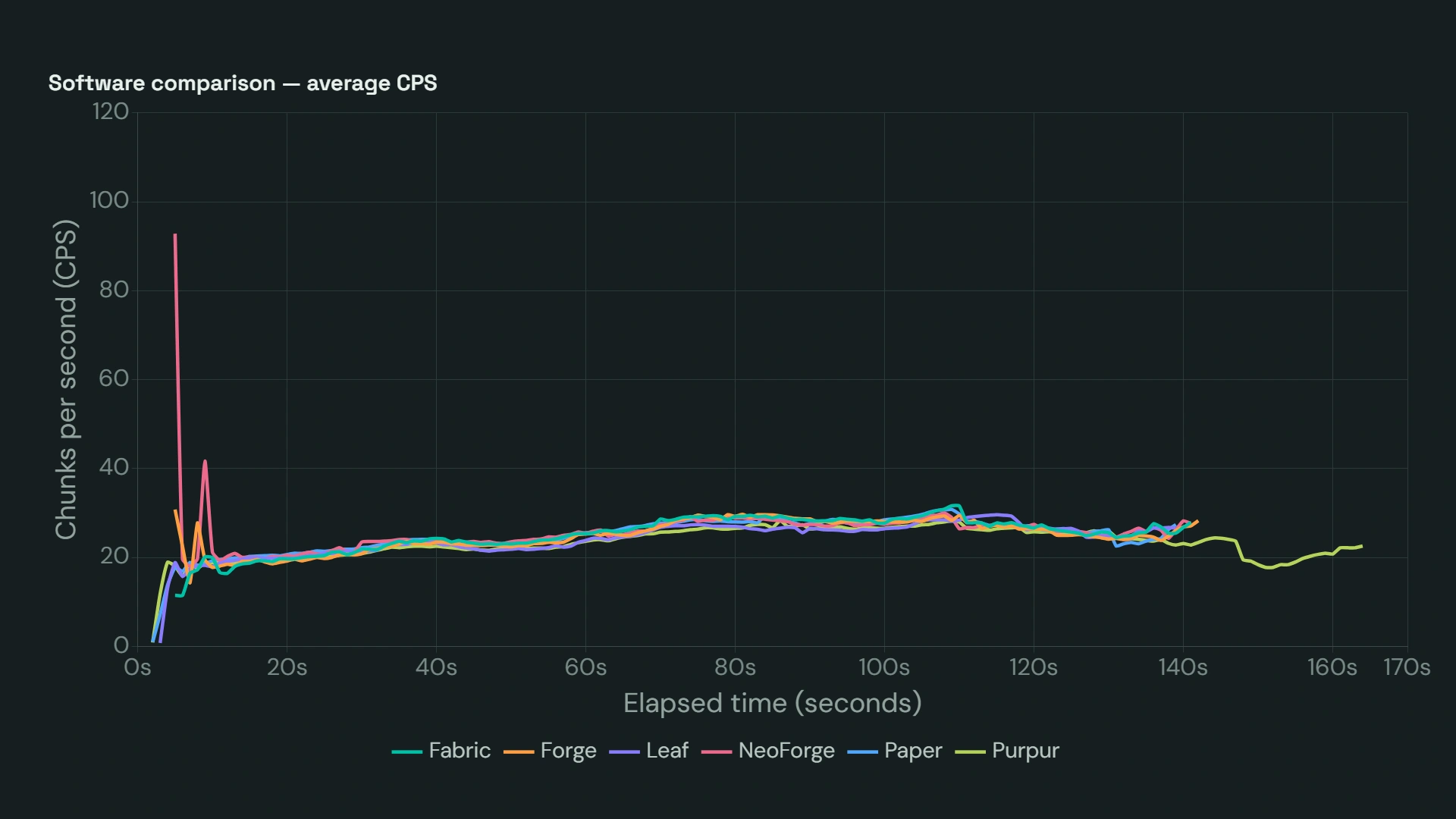
On the Orange Pi 5, Paper averaged 33.47 CPS and Fabric averaged 33.35 CPS. NeoForge followed at 33.19 CPS. Purpur was the slowest at 31.70 CPS, but the entire spread was only about 5.6% from slowest to fastest.
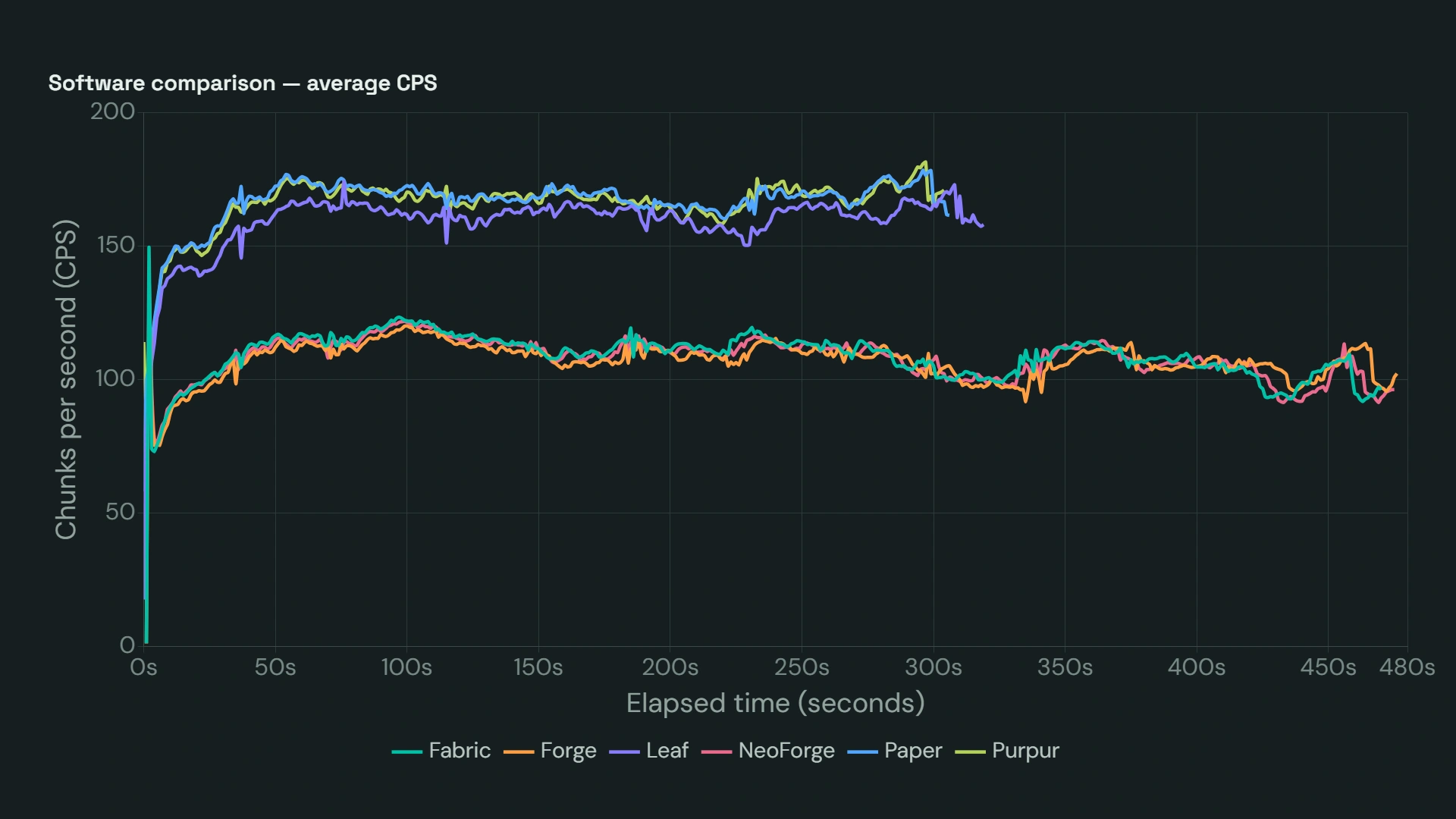
The custom server tells a very different story. Paper averaged 214.80 CPS, Purpur 213.51 CPS, and Leaf 205.28 CPS. Forge was the slowest at 137.37 CPS. Paper therefore produced about 56% more throughput than Forge in this setup.
Average throughput and completion time
| Software | Orange Pi CPS | Orange Pi time | Custom server CPS | Custom server time |
|---|---|---|---|---|
| Paper | 33.47 | 127.0 s | 214.80 | 293.9 s |
| Purpur | 31.70 | 134.9 s | 213.51 | 295.3 s |
| Leaf | 32.06 | 132.3 s | 205.28 | 307.2 s |
| Fabric | 33.35 | 128.0 s | 139.94 | 451.0 s |
| NeoForge | 33.19 | 128.9 s | 138.72 | 455.0 s |
| Forge | 32.72 | 130.7 s | 137.37 | 459.3 s |
Resource usage
These are averages over the benchmark runs. CPU is process CPU, so values above 100% mean the server used more than one logical core. Memory is the average process resident set size. Temperature is the average package temperature reported by the host.
| Software | Orange Pi: CPU / memory / temperature | Custom server: CPU / memory / temperature |
|---|---|---|
| Fabric | 358.8% / 3,347 MiB / 69.5 °C | 425.0% / 4,354 MiB / 89.1 °C |
| Forge | 361.7% / 3,384 MiB / 68.7 °C | 408.9% / 4,254 MiB / 88.4 °C |
| Leaf | 282.9% / 4,356 MiB / 68.2 °C | 434.8% / 4,738 MiB / 96.3 °C |
| NeoForge | 361.8% / 3,486 MiB / 69.4 °C | 423.1% / 4,383 MiB / 89.2 °C |
| Paper | 282.6% / 4,251 MiB / 65.0 °C | 437.3% / 4,673 MiB / 96.2 °C |
| Purpur | 281.2% / 4,253 MiB / 68.2 °C | 437.1% / 4,679 MiB / 96.4 °C |
The resource numbers make the custom-server result more interesting. Paper and Purpur were the fastest, but they also averaged around 437% process CPU and 96 °C package temperature. Forge used less memory and had a lower average temperature, but it took much longer to finish.
The seed still matters
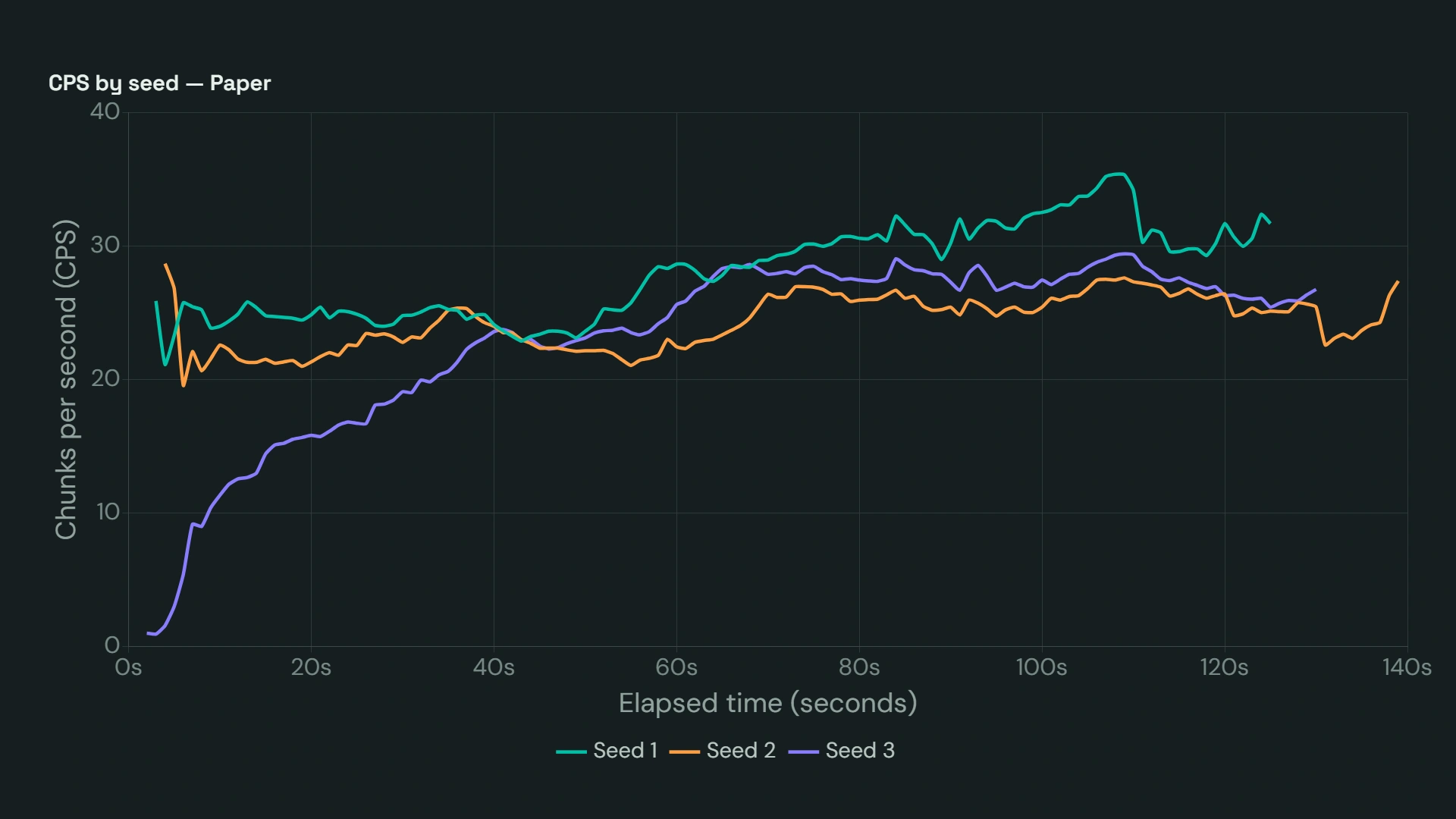
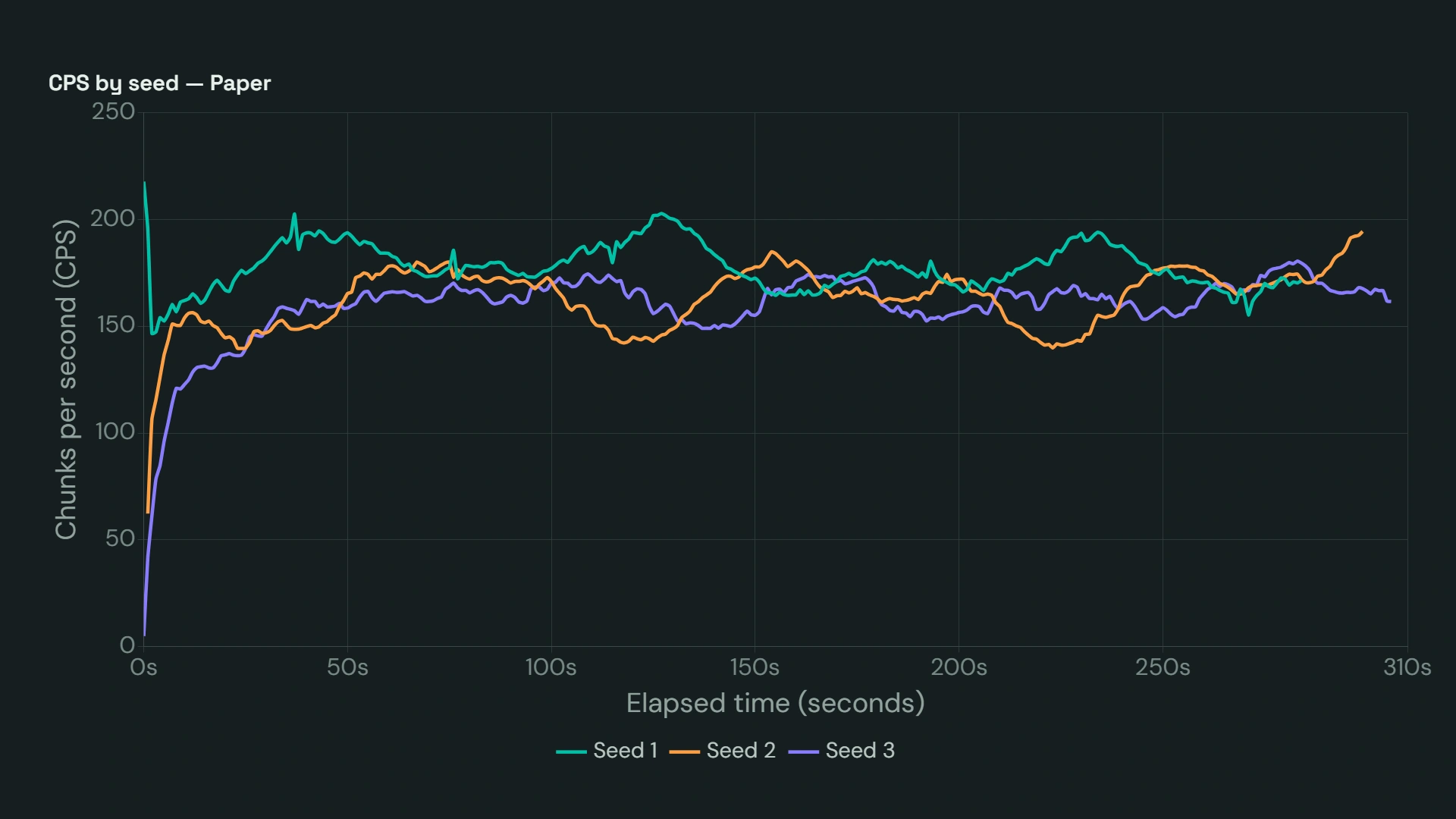
The seed-level graphs show why a single run is not enough. The three lines do not behave identically, especially while the benchmark is warming up. For Paper, mean throughput across the three Orange Pi seeds ranged from 31.57 to 36.67 CPS; on the custom server it ranged from 206.34 to 227.34 CPS. This is seed-to-seed variation in a three-seed sample, not a confidence interval. The custom server generated about 15 times as many chunks per run, so its average reflects a much larger terrain sample. Repeating each seed three times also reduces dependence on one run, though three seeds cannot represent every world.
The changes in CPS depend on the generated biome. A jungle, with all the trees, is much more difficult to generate than a plain biome!
What surprised me
- The Orange Pi 5 largely erased the software differences. Paper, Fabric, and NeoForge were separated by less than 1 CPS.
- Paper and Purpur were close overall on the custom server: Paper averaged 214.80 CPS and Purpur 213.51 CPS, a difference of 1.29 CPS (about 0.6%). By seed, Paper led by 5.24 CPS on seed 1, while Purpur led by 0.70 CPS on seed 2 and 0.68 CPS on seed 3. These results do not show that Purpur’s extra configuration caused any big difference.
- Leaf was close to Paper and Purpur on the custom server, but not on the Orange Pi 5. The “fastest” Minecraft server software claim is now gone on their website too.
- The mod-loader-based options did not all scale the same way when moving to the faster machine. Forge, Fabric, and NeoForge stayed around 137–140 CPS while the plugin-oriented options moved above 200 CPS.
My conclusion
If you are running on hardware similar to the Orange Pi 5, common on cheap hosts, software choice alone probably will not transform chunk generation. Paper is technically the fastest in this dataset, but the difference from Fabric and NeoForge is small enough that compatibility, features, and maintenance should matter more.
On the custom server, Paper and Purpur are the clear performance winners for this benchmark. Leaf is also competitive. Forge, Fabric, and NeoForge were much slower at generating the larger test area, although that does not make them bad choices for modded gameplay. They serve a different purpose, and chunk generation is only one workload.
The biggest lesson is that benchmark results do not transfer cleanly between machines. The same software can look almost equal on a small ARM board and dramatically different on a faster x86 server.
Limitations
This post measures Chunky chunk generation. It does not measure player load, redstone, entities, farms, plugins, modpacks, disk latency in isolation, or long-term tick stability. The two machines also used different generation radii. Treat these results as a reference for this exact setup, not as a universal ranking.
Leave a Reply